

Diagnosing Kidney Cancer
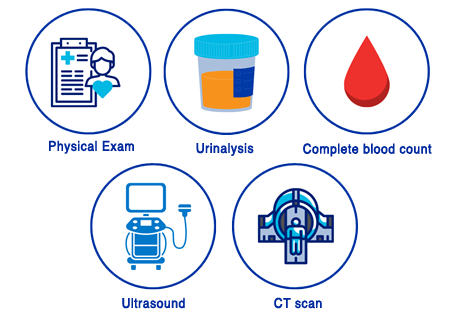
If you have a mass in your kidney, you will undergo a series of tests to make an accurate diagnosis. Advanced imaging and laboratory tests allow the care team to examine your kidney tumor and recommend the most effective treatment approach.
Laboratory Tests
- Urinalysis: Your urine tells us a lot about your kidneys. Urine is tested for traces of blood, high levels of protein and infection. Blood is found in the urine of about half of kidney cancer patients.
- Blood tests: Blood tests include a complete blood count (CBC). Low levels of red blood cells, a condition called “anemia,” is common in people with kidney cancer. Other blood chemistry analysis lets us know if your kidneys are filtering nutrients and functioning properly.
Imaging
Biopsy
A biopsy tests your kidney tissue for cancer. A biopsy is performed under local anesthesia. A needle is inserted directly into the kidney and a small amount of tissue is taken. The tissue is examined under a microscope, to identify cancer cells and the grade of tumor.
Genomic Testing
Your tumor tissue may undergo genomic testing. This identifies DNA mutations in your cancer cells. The resulting genomic profile of your cancer gives us information on what caused your cancer, which treatments will be most effective, and if there are clinical trials for your precise type of kidney cancer.
Stage and Grade
When you are diagnosed with cancer, your cancer will have a stage. If your cancer has been biopsied, it also will have a grade. The stage and grade help determine your treatment.
Stage
How much cancer is in your body, based on the size of your tumor and if it has spread to your lymph nodes and other parts of your body. The stages* of kidney cancer are based on:
T (Tumor): The size and growth of the tumor
N ( Lymph Nodes): If the cancer has spread to nearby lymph nodes
M (Metastasis): If the cancer has spread (metastasized) to distant lymph nodes, bones, or organs such as the lungs, liver or brain.
Grade
The grade of tumor describes how the tumor appears under a microscope. Understanding your cancer at the cellular level and how it will likely grow helps us match you with the best treatment possible.
Localized or Advanced
Questions to Ask Your Doctor
•What is my type of kidney cancer?
•What is the stage and grade of my kidney cancer?
•What can you tell me about my prognosis?
•What can I expect in my treatment plan?
•Do you know what caused my kidney cancer?
•Should my cancer get genomic testing?
•What are the next steps?